 Atlas
Atlas
Customer, building and unit records in pest control
In pest control a customer record cannot stop at a name and a phone number: it has to go down to the treated unit, because that is where the work actually happens. Atlas structures each customer into buildings and then units, and ties every job to the right door. Atlas does no sales prospecting and keeps no books.
- Structure
- Customer, then building, then unit, on three levels
- Customer types
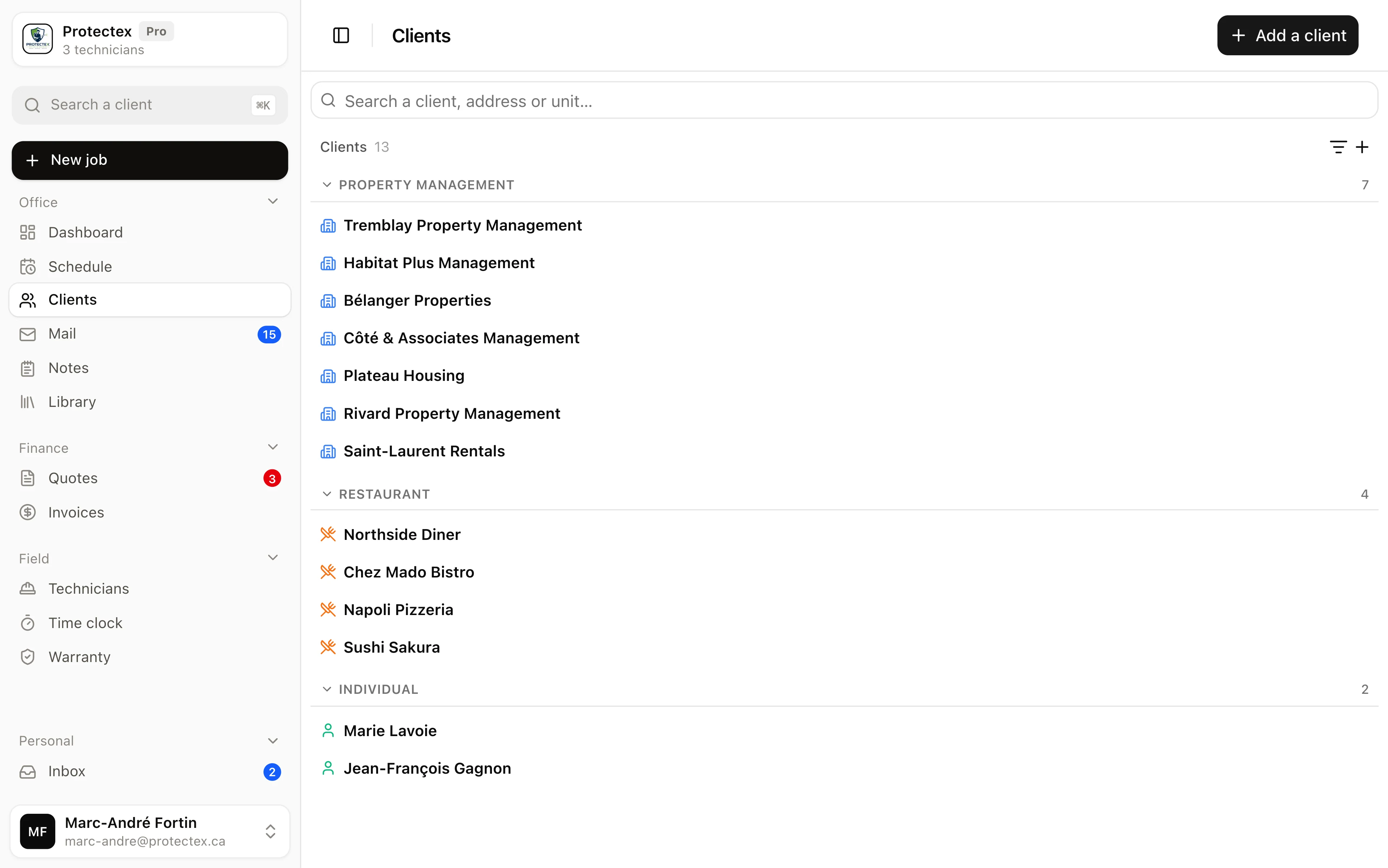
- Six types to pick from: individual, property management, restaurant, bakery, warehouse, other
- Residential
- The unit can be free text, for example "Apt 3"
- History
- Attached to the unit, not only to the street address
- Sharing
- A customer can be given read-only access to their own portfolio
Why is a street address not enough in pest control?
Because a thirty-unit building is not one customer, it is thirty files. The question you get asked is always about one specific door.
Bed bugs move from one apartment to the next, cockroaches travel through plumbing columns, and the tenant on the third floor refuses access while the one on the fifth is calling back for the second time.
If all the history sits under a single address line, nobody can answer the question that matters, what was done behind that specific door and when. Atlas therefore goes down to the unit, which turns an address into a real file you can read door by door.
How is a building structured in Atlas?
On three levels: the customer, the building, then the unit. History accumulates and warranties are calculated at unit level.
On three levels, and the order matches how the trade actually works.
- The customer
- is the one who signs and who calls. Six types to pick from: individual, property management, restaurant, bakery, warehouse and other.
- The building
- is the physical site, with its address. One customer can hold ten of them across the city.
- The unit
- is the treated door. This is where history accumulates and where warranties are calculated.
What about a homeowner with no building and no unit number?
The unit can be typed as free text, something like "Apt 3". You never have to create a fake building just to record a visit at a house.
They are not forced into a hierarchy that does not exist at their place. The unit can simply be typed as free text, something like "Apt 3" or "basement", attached to the job.
It is a small design decision that avoids the usual trap in management software, the one that makes you create a fake one-unit building just to record a visit at a house. You keep the fine structure where it earns its keep, in multi-unit buildings, and stay fast on simple jobs.
What does a well-structured record change when the phone rings?
It turns a vague call into a precise answer. You drill down to the unit and see the sequence of visits within seconds.
A property manager reports pests coming back on the fourth floor: you open their building, drill down to the unit, and see the sequence of visits, the pests targeted, who came and what was noted.
You immediately know whether that unit has already been treated three times, whether access was refused, and whether a warranty is still running on that pest. The customer record also lets you share the right information at the right level, since a customer can be given read-only access to their own portfolio without seeing anyone else's.
What Atlas does not do
- No automatic import of an existing customer file, records are created in the tool
- No sales tracking and no prospect follow-up
- No bookkeeping and no export to accounting software
Frequently asked questions
Can one customer hold several buildings?
Yes. A customer can carry as many buildings as needed, each with its own units. That is the normal situation for property managers who hand a whole portfolio to the same pest control company.
Is history attached to the address or to the unit?
To both, but the useful level is the unit. You can read the full history of a building, then drill down to a specific door to see only what happened there.
How do you handle a homeowner with no building?
The unit can be typed as free text on the job, for example "Apt 3". You do not need to create an artificial building just to record a visit at a house.
Can an existing customer list be imported?
No, Atlas does not offer automatic customer file import today. Customers, buildings and units are created inside the tool.
Read next
Build a full building in five minutes
Create a customer, add their buildings and units, and schedule a first visit. No commitment.