 Atlas
Atlas
Role-based access, everyone sees only what concerns them
Role-based access means showing each person only the data they need to do their job, and nothing more. Atlas walls off three roles: the office, which sees everything, the technician, who sees only their assigned jobs, and the customer, who sees only their portfolio read-only. Atlas does not offer custom roles or fine-grained permission checkboxes.
- Roles
- Office, technician, customer
- Technician
- Only their assigned jobs, nothing about colleagues
- Customer
- Only their portfolio, read-only
- Isolation
- Double filter on the person and on the company account
- Sign-in
- Field and customer access by token link, no password
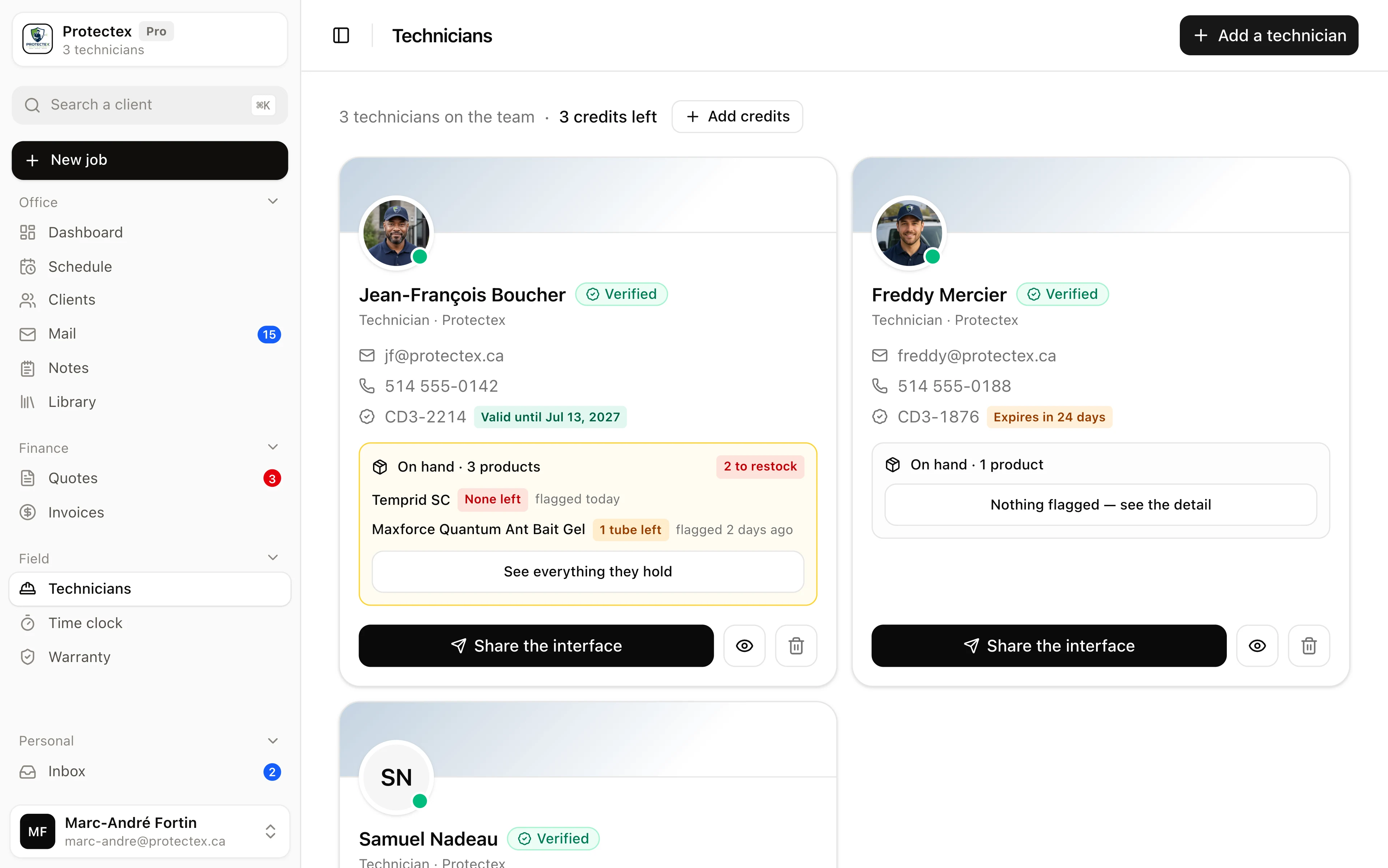
What does a technician see, and what do they not see?
They see their jobs for the day, and nothing else. Not their colleagues' routes, not your customer list, not the company settings.
They see
- Their jobs for the day, in order
- The address and the unit concerned
- The visit type and the pest targeted
- What they need to tick the job on site
They do not see
- Their colleagues' routes
- The full customer list
- The company settings
- Any data from another account
This separation is not about mistrust, it is about clarity and risk. Clarity, because a screen showing only one person's day is readable in two seconds in a building hallway. Risk, because a phone gets lost, lent and resold, and a mislaid device must never carry your whole customer file with it.
How does Atlas guarantee no data leaks between accounts?
With a double filter on every read, on the person and on the company account. Both conditions must hold for any data to appear.
With a double filter applied on every read. When a technician opens their workspace from their link, Atlas does not only check the token, it also filters on the owning company account.
In other words two conditions must hold at the same time for a job to appear: it must be assigned to that technician and belong to that company. The result is that a token, even misused, cannot reach another account's data. No other data, neither other technicians nor other customers, is reachable from that access.
On the customer side, how far does access go?
The customer gets a link to their own portfolio, read-only, with no way to change or create anything.
The customer receives a link to their own portfolio, read-only. They consult their buildings, units and the visits concerning them, with no way to change, cancel or create anything.
Your notes flagged private never reach that side, which lets you document a difficult situation plainly. And because the link is revocable, a change of contact or the end of a contract is handled by disabling the access, without asking anyone to delete an account.
Why does Atlas not offer fine-grained permissions?
Because in a team of three to fifteen people, fine-grained permissions cost more than they return. Three clear-cut roles do not drift.
A grid of thirty checkboxes per person always ends the same way: somebody switches everything on to unblock a situation on a Friday night, and the separation no longer exists. Three clear-cut roles are understood in one sentence, do not drift, and can be verified at a glance. If your organization genuinely needs finer rights, that is a real need, but it is not the one Atlas answers today.
What Atlas does not do
- No custom roles and no permission checkboxes
- No detailed audit log of who viewed what
- No team hierarchy, crew leads or territories
Frequently asked questions
Can a technician see my customer list?
No. Their access only opens the jobs assigned to them. The customer list, other technicians and company settings are not reachable from their workspace.
What happens if a technician loses their phone?
The device only carried that person's day, not your customer file. Their access link can be replaced, and nothing else was reachable from it.
Can two companies see each other's data?
No. Every read is filtered on both the person and the account that owns the data. Both conditions must hold, which prevents any leak between accounts.
Can an intermediate role such as crew lead be created?
No, not today. Atlas works with three roles: office, technician and customer. There are no custom roles and no team hierarchy.
Read next
Check the separation yourself
Create a technician, open their link, and see what they can reach. No commitment.