 Atlas
Atlas Feature
The paperwork of the trade, on your letterhead and under your country's rules
Pest control documents built at a click, on your letterhead, under your country's rules. Eleven in Quebec, nine handouts in English Canada, the United States and France, seven in the UAE.
In short
A document library is where a pest control business gets the paperwork it has to hand over, have signed, or leave behind.
- How many documents
- Eleven in Quebec, two service agreements and nine client handouts. Nine handouts in English Canada, the United States and France. Seven preparation sheets in the Emirates
- Which countries
- Quebec, English Canada, the United States and France, with different wording each time. In the Emirates, a general template to adapt
- In your name
- Logo, name, contact details and color of the account, on every page
- Your license
- Your number prints itself on the post-treatment notice
- Pests covered
- Bed bugs, cockroaches and ants, treatment and prevention alike
- Format
- PDF, built the moment you click, to print, save or email
- Pinning
- The documents you pull most stay at the top of the list
- What it costs
- Included in the plan, no charge per document
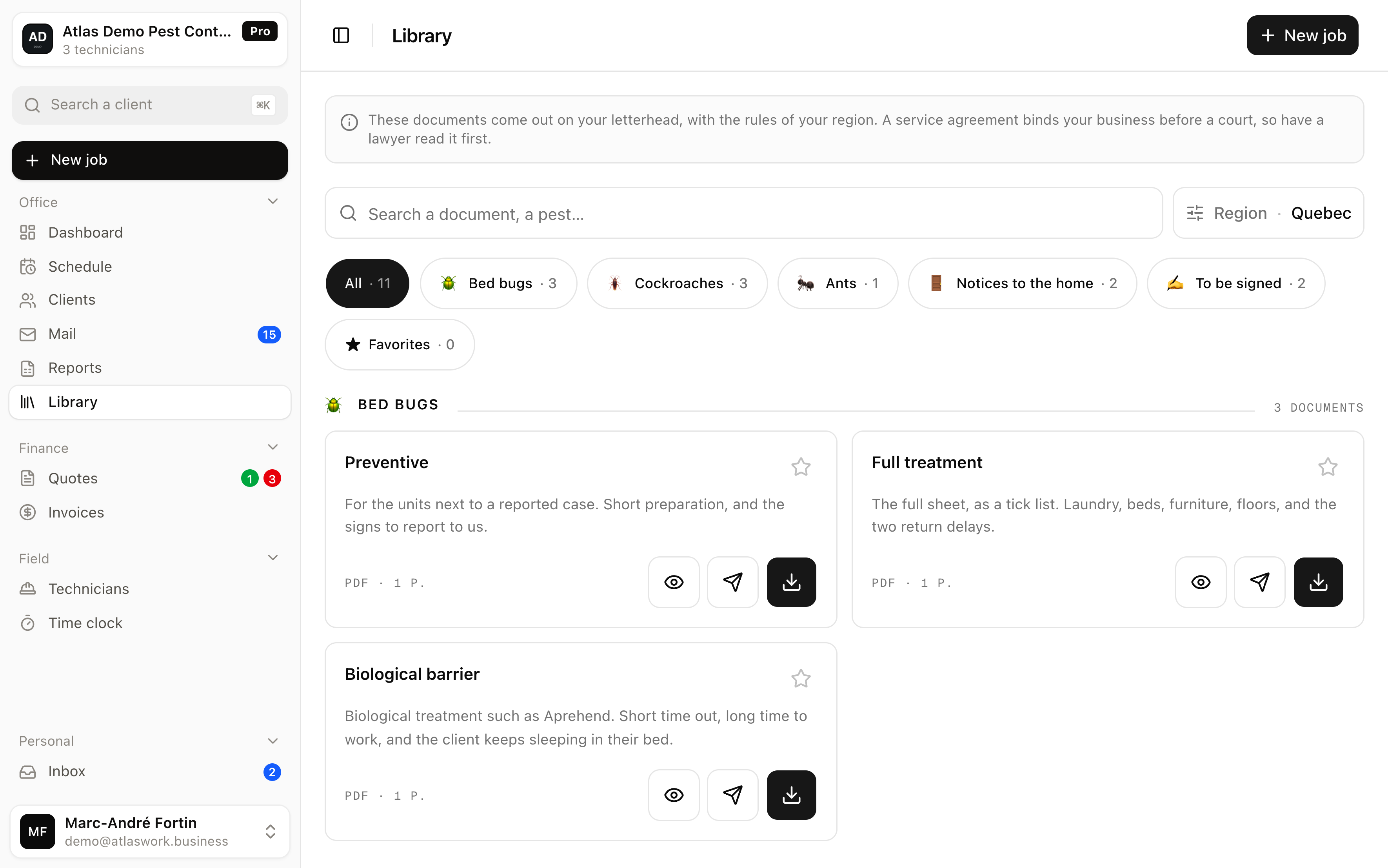
Atlas builds them at a click, as PDFs ready to print or send. Quebec has eleven, two service agreements and nine client handouts. English Canada, the United States and France have the nine handouts, without the agreements, which have not been written for their law yet. The Emirates get seven preparation sheets as a general template to adapt. Each one comes out on your letterhead, with your logo, your contact details and your color, and carries the regulatory frame of your region. Atlas does not fill in the client's name or the unit address and signs nothing online. You print the document, save it, or email it to the client from Atlas.
Is a post-treatment notice mandatory in Quebec?
Yes. Section 48.4 of the pesticide management code requires a written notice after an application in a residential building. Atlas builds it with your license number on it.
It is the most regulated document of the trade, and the one most often retyped by hand. It carries the heading «PESTICIDE TREATMENT», the product used with its registration number, the delay before the unit can be re-entered, and what to do if someone has been affected.
Three re-entry delays are offered separately, because they are not the same for everyone. A healthy adult, a vulnerable person, an animal. Writing all three heads off the question asked on the doorstep, and above all keeps a tenant from going back in too early.
The Quebec Poison Control Centre number, 1-800-463-5060, is printed on it, and your application license number fills itself in from your settings. Two details almost always missing from a Word template carried over year after year.
What does the country change on a document?
The regulatory frame, the emergency number, the name of the registration number, the certification required of the technician and the governing law. In other words, almost everything that carries legal weight.
- Quebec
- Products registered with Health Canada and the pesticide management code, PMRA registration number, certificate issued under the Pesticides Act, and the reminder that the landlord owes twenty four hours' notice before work, between 7 a.m. and 7 p.m., articles 1931 and 1933 of the Civil Code.
- English Canada
- The same federal products, but a technician licensed in their own province, and the notice period before a visit pointing to provincial law rather than a named article. The nine handouts, without the service agreements, which were written for Quebec law.
- United States
- The frame and vocabulary of the country, with the notice period before a visit pointing to state law. The nine handouts, without the service agreements.
- France
- TP18 biocidal products compliant with EU Regulation No 528/2012, a technician holding the Certibiocide certificate, the AMM or inventory number, and 15 or 112 in an emergency. The nine handouts, reviewed for French law, without the service contracts.
- United Arab Emirates
- Seven preparation sheets, without a post-treatment notice. They cite no law, no authority and no emergency number, and carry the heading «general template to adapt».
The region is set once, in Settings, and the whole library follows. American software will give you very handsome sheets, written for a frame that is not yours, and that is exactly the kind of detail an inspector looks at.
What are the preparation sheets for?
For the unit to be ready on the day of the visit. A poorly prepared unit gets treated twice, and the second visit comes out of your pocket.
This is the sheet you slide under the door or hand to the property manager a few days ahead. It says what the occupant has to do, in what order, and what they must absolutely not do, such as moving their things from one room to another and carrying the bed bugs along with them.
- Bed bugs, three sheets
- Full treatment, prevention, and barrier treatment for when the unit is not emptied. Three different preparations, three different sheets.
- Cockroaches, three sheets
- Treatment, prevention, and dust application, which needs instructions of its own.
- Ants
- The preparation sheet for the treatment.
- Inspection notice
- The one you leave before you know what you are dealing with, to announce the visit and ask for access.
These sheets go to the client as they are, with no legal review. A service agreement, on the other hand, binds your business before a court, and Atlas says so at the top of the screen rather than letting you find out later.
Do the documents really come out in my name?
Yes. Your logo, your business name, your contact details and your color, on every page, with nothing for you to retype.
That is what separates a downloaded template from a company document. A property manager who receives three generic sheets and a fourth on your letterhead does not treat them the same way, and a tenant who keeps the notice on their fridge for two weeks has your number in front of them.
The PDF is built in your browser the moment you click, from your account settings. Change your logo or your address and the next document comes out up to date, with no template to edit somewhere.
What does it actually save?
The time to redo a document you have been redoing for years, and the risk of leaving behind a piece of paper that does not say what the law asks for.
The real cost of a Word template is not the time to fill it in, it is that it ages without warning. A poison control number changes, a legal article is renumbered, a re-entry delay is revised, and the document keeps coming out unchanged for three years, because nobody has a reason to open it again.
Then there is what nobody counts, the visit redone because a unit was not prepared, the tenant who went back in too early, the property manager asking for the certificate again six months later. A clear piece of paper handed over at the right moment costs a few seconds, and the absence of that paper is paid for in drive time.
What the library does not do
- The client's name, the address and the unit are not filled in for you. The document comes out on your letterhead, not in the recipient's name.
- Emailing is capped at ten documents a day. Beyond that, save the PDF and send it yourself.
- Service agreements are offered in Quebec only. Elsewhere the library offers the client handouts, and in the Emirates a general template to adapt, without local rules.
- No online signature. An agreement is signed on paper, as before.
- The text of the documents cannot be edited. They are verified templates, not a word processor.
- You cannot upload your own documents into the library.
- This is not legal advice. A service agreement binds your business, have a lawyer read it once before you rely on it.
Frequently asked questions
Eleven in Quebec. Two service agreements, annual and monthly, and nine client handouts, the inspection notice, the post-treatment notice, three bed bug sheets, three cockroach sheets and one ant sheet. English Canada, the United States and France have the nine handouts, without the agreements. The Emirates get seven preparation sheets as a general template to adapt.
Yes, it fills itself in from your settings. It is the detail people forget on a hand-filled template, and it is the first one an inspector looks for.
Yes, and not only in language. The regulatory frame, the emergency number, the name of the registration number, the certification required of the technician and the governing law all change. In the Emirates, the sheets cite no law and no authority, and it is up to you to adapt them.
No. They are verified templates, written for a given regulatory frame, and letting them be retouched would lose the only thing that makes them useful. You pick the document and the country, Atlas builds the rest.
Yes. The Send button attaches the PDF to an email to your client, in the language you choose, with a note if you like. Up to ten documents a day, and the PDF sent is the one you previewed.
Yes, at no extra cost. As many documents as you like to print or save, and up to ten emailed a day. The library is part of the plan, at the monthly price of your country, one technician included.
See the library
The demo opens with no account. Pick a country, open a document, watch what changes.