 Atlas
Atlas
The read-only client portal for a pest control company
A client portal is an interface where the customer checks the progress of their jobs themselves, without phoning or waiting for an email. In Atlas that portal is read-only, opens from a private link with no account to create, and shows only that customer's portfolio, building by building and unit by unit. The customer cannot change anything, never sees your private notes and cannot reach any other customer.
- Access
- Private link with a token, no account and no password
- Rights
- Read-only, no action possible on the customer side
- Content
- Their buildings, their units and the visits concerning them
- Confidentiality
- Notes flagged private never appear there
- Revocation
- The link can be disabled and becomes invalid
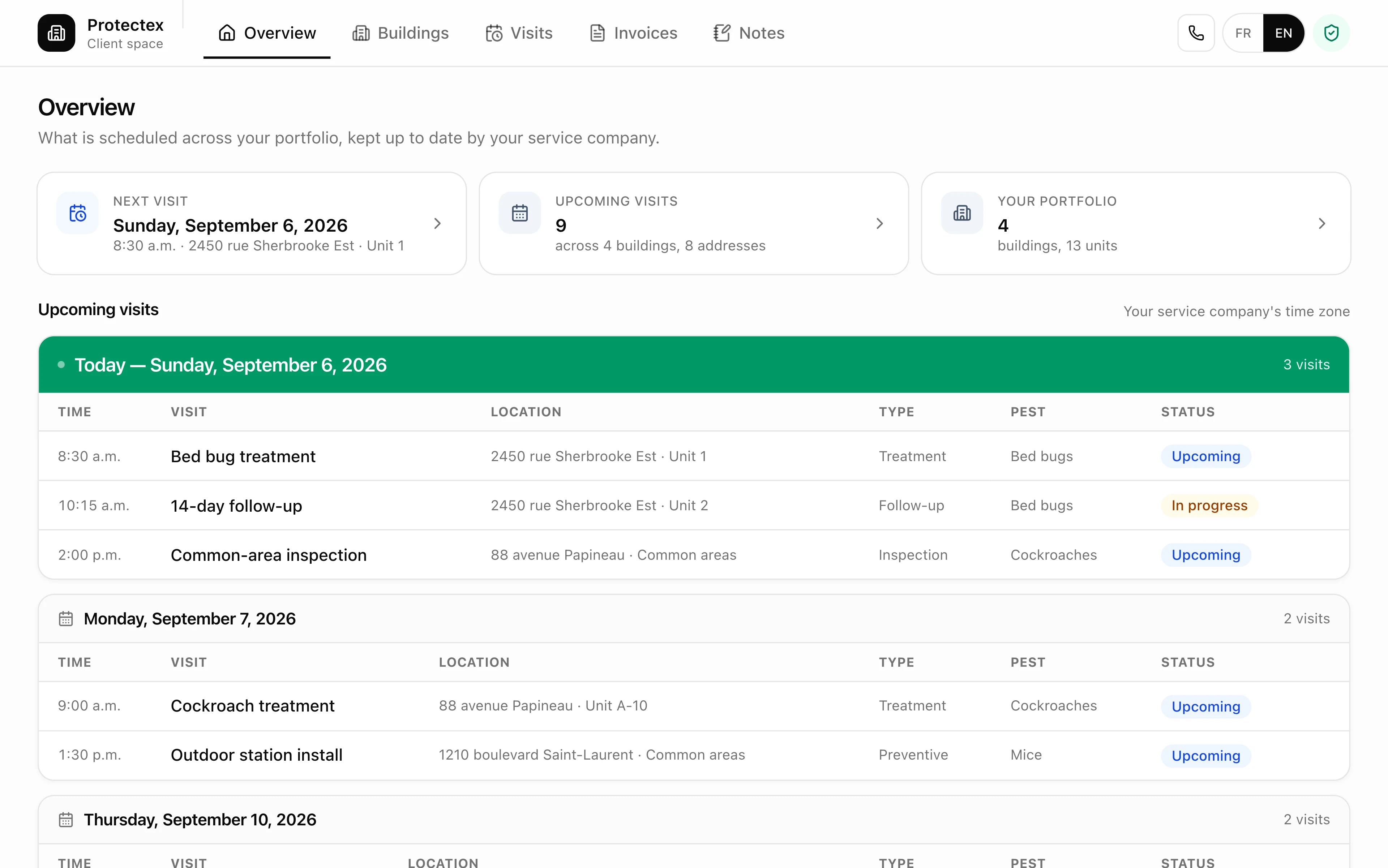
What exactly does a property manager see in the portal?
They see their portfolio, and only theirs. Their buildings, their units, and the visits concerning them, continuously up to date.
The left column lists their buildings, which they open down to the units, with the same tree used internally. For each unit they find the visits that concern it. That answers the three questions every customer asks: did someone come, where, and where do we stand. Because the information stays current, they no longer have a reason to call and ask for it, which is the real gain for a field crew.
Why a link instead of an account to create?
Because an account that has to be created never gets created. The private link opens on the first click, with no password to remember or reset.
Someone invited to sign up for software they did not choose puts it off, and you keep answering the phone. A private link removes that friction: it opens on the first click, on a phone or a computer, with no password to remember or reset six months later. The link carries a token that opens only that customer's portfolio, and you can disable it whenever you want, at which point it becomes invalid.
What does the customer never see?
Your private notes, other customers, and your internal organization. That is exactly what makes sharing possible at all.
What they see
- Their buildings and their units
- Upcoming visits and completed ones
- The notes you did not flag private
What they never see
- Your notes flagged private
- Other customers and their buildings
- Dispatch between your technicians
- Your company settings
That separation is what makes sharing possible at all. An unsanitary unit or a tenant refusing to prepare can be documented plainly, without the customer reading it. And because the link opens a single portfolio, two property managers never cross paths.
What does it change in the relationship with a customer?
A manager who has the link opens their portfolio and the checking call never happens. You stop selling transparency and simply hand it over.
It moves the conversation. A manager who doubts the contract is being honored calls, complains, and you spend thirty minutes reconstructing what was done. A manager who has the link opens their portfolio, sees the visits, and the call never happens.
In a tender it is also a concrete argument against competitors who promise follow-up without showing how. You stop selling transparency and simply hand it over, at the cost of sending a link.
What the portal does not do
- The customer cannot request a job or change anything, it is strictly read-only
- No online payment and nothing the client can write, they read and save their invoices as PDF, nothing more
- No notification is sent to the customer, they check whenever they want
Frequently asked questions
Does the customer need an account?
No. They open a private link, with no sign-up and no password. The link carries a token that grants access to their own portfolio only.
Can the customer change or cancel a job?
No. The portal is strictly read-only. They consult their buildings, units and the visits concerning them, with no action available.
Can access be revoked?
Yes. The link can be disabled and becomes invalid. That is useful at the end of a contract or when a contact changes on the customer side.
Does the customer see my technicians' notes?
Only the ones not flagged private. A private note never appears in the portal, which lets you document a difficult situation plainly.
Read next
Send a portal to your biggest customer
Build their portfolio, share the link, and count the follow-up calls next month. No commitment.